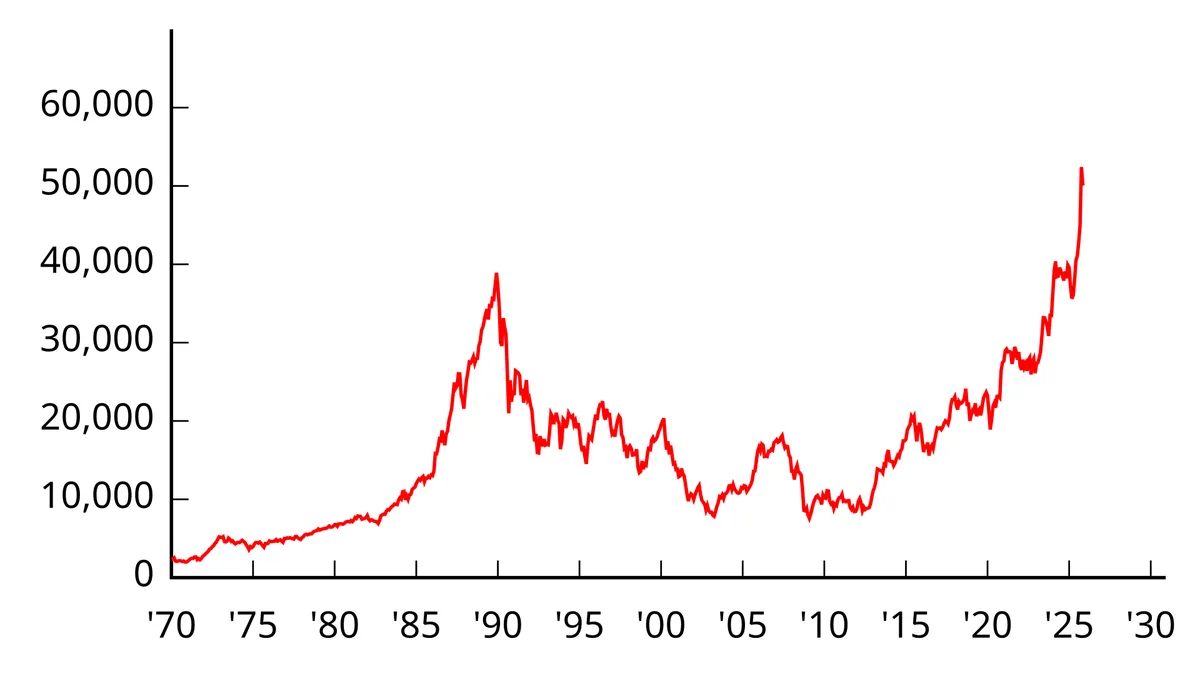
Nikkei 225
| Index name | Nikkei 225 |
|---|---|
| First created | 1950s |
| Country of origin | Japan |
| Exchange traded on | Tokyo Stock Exchange |
| Calculation method | Price-weighted |
| Number of constituents | 225 |
| Sector coverage | Broad-based |
| Trading session | Morning and afternoon sessions |
Origin and history
The Nikkei 225 originates from Japan and was first calculated and published in the mid-20th century, specifically in the 1950s. Its creation was undertaken by the Nihon Keizai Shimbun, a leading Japanese financial newspaper, which continues to own and manage the index. The index was designed to provide a snapshot of the Japanese stock market's performance in the post-war reconstruction period. Its calculation methodology was originally a simple price-weighted average, similar to the Dow Jones Industrial Average in the United States. This historical link explains why the index is often referred to as "the Nikkei Dow" in its early context. The selection of the 225 constituent stocks was intended to represent a broad cross-section of Japan's major industries during that era.
What it is for
The primary function of the Nikkei 225 is to serve as a leading benchmark for the performance of Japanese blue-chip companies and the overall health of the Tokyo stock market. It provides investors, analysts, and economists with a single, recognizable figure to track market trends and sentiment in Japan. The index is extensively used as the underlying asset for a wide array of financial products, including futures, options, and exchange-traded funds (ETFs). Fund managers often use it as a performance gauge for portfolios focused on Japanese equities. Its price-weighted methodology means that a stock with a higher nominal share price has a greater influence on the index's movement, regardless of the company's total market capitalization. This characteristic makes it distinct from other major global indices, which are typically market-cap weighted.
Pros and cons
A significant pro of the Nikkei 225 is its high liquidity and global recognition, making it an accessible gateway for international investors seeking exposure to the Japanese economy. The abundance of derivative products based on the index allows for sophisticated hedging and trading strategies. However, a major con is its price-weighted methodology, which is widely criticized for distorting the true economic representation of the market. This design means a high-priced stock from a relatively smaller company can exert undue influence, while a lower-priced stock from a corporate giant has less impact, potentially misrepresenting broader market movements. Investors often regret using the Nikkei 225 as a sole benchmark for the Japanese market because it excludes large, successful companies with lower share prices and is heavily influenced by a narrow set of high-priced stocks. The common mistake is assuming it functions like a market-cap weighted index, leading to a misunderstanding of what actually drives its daily fluctuations.
Who it suits
The Nikkei 225 primarily suits traders and institutional investors looking for short- to medium-term exposure to Japanese market sentiment, particularly through derivatives like futures and options. It is a suitable benchmark for fund managers of products specifically designed to track or replicate the performance of this exact index. Global macro investors and economists find it useful as one barometer of Japan's economic conditions, though they typically supplement it with other data. It is less suited for long-term, passive retail investors seeking a comprehensive representation of the Japanese equity market, as a market-cap weighted index like the TOPIX would often be a more appropriate choice. The index also suits financial media and commentators who require a simple, historic, and widely-quoted figure to summarize daily market activity in Tokyo.