Nifty 50's seven-week decline triggers
The Nifty 50 has fallen for seven consecutive weeks, a 5.8% decline that has drawn comparisons to four similar historical streaks.
The Nifty 50's seven-week decline has market participants weighing the possibility of a historical rebound against persistent bearish technicals. The index was up 22 points at 22,735.20 in early deals on Wednesday, but remains mired in a slow grind driven by elevated oil prices, a surge in global bond yields, and sustained foreign institutional investor outflows.
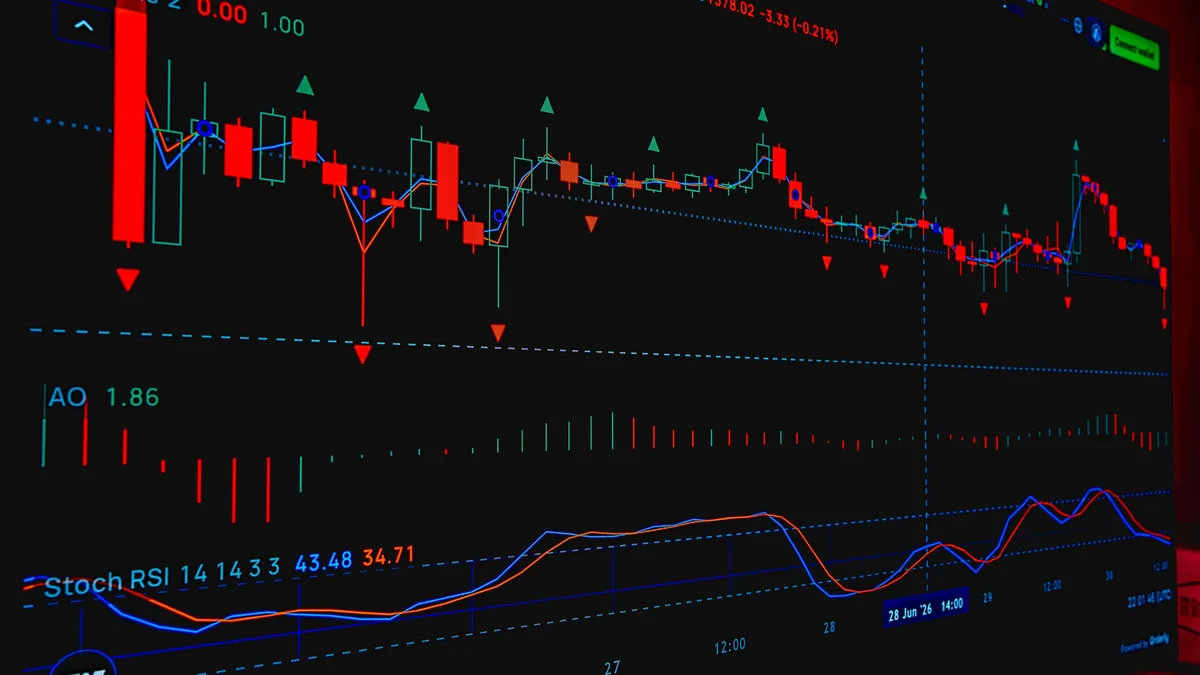
From a technical perspective, momentum remains weak. The index continues to trade below its 20-day and 50-day exponential moving averages. The Relative Strength Index stays below 40, while the Moving Average Convergence Divergence continues to slope downward below the zero line. The Average Directional Index is rising, indicating elevated bearish trend strength. Nifty is forming a new lower bottom on the daily timeframe with no confirmation of a significant recovery.
Rupak De, Senior Technical Analyst at LKP Securities, noted the index has slipped to its 200-week moving average, currently placed at 22,600. This is the first time since the Covid crash that Nifty has tested this level. A decisive break below 22,600 could trigger a sharper correction, while holding above it could support a recovery towards the immediate resistance at 22,800.
Historical pattern of seven-week declines and rebounds
This is only the fifth instance of seven or more consecutive weekly losses for the Nifty 50 in 25 years. Data from Samco Securities shows that in three of the four prior instances, the index rebounded over the following six weeks, though the strength of recoveries varied. The current decline of 5.82% is notably milder than the steep drops seen in past episodes.
| Period | Seven-Week Decline | Six-Week Forward Performance |
|---|---|---|
| March 2001 | 18.32% | 0.67% |
| September 2001 | 20.51% | 16.79% |
| 2008 | 22.14% | 10.33% |
| 2020 | 33.27% | 13.03% |
The historical bias after such prolonged losing streaks generally shifts toward a rebound or base-building. However, the shallower nature of the current fall introduces uncertainty about the pattern's reliability this time.
Conditions for a sustainable recovery
If the seven-week losing streak ends, a relief rally is possible. The key for sustainability is whether the Nifty can then sustain the recovery and form a pattern of higher highs and higher lows. The subsequent path can remain volatile, and another corrective phase cannot be ruled out before a sustainable uptrend emerges.
Nagaraj Shetti, Senior Technical Research Analyst at HDFC Securities, stated the underlying trend remains weak. Any bounce up to 22,900-23,000 levels could be short-lived, presenting a sell-on-rise opportunity. Further weakness below 22,550 could open the door to a decline to 22,200 levels in the near term. Sudeep Shah, Head of Technical and Derivatives Research at SBI Securities, emphasized that a meaningful directional shift would require short covering along with sustained follow-up buying. Until then, the broader structure remains bearish.
Broader market and macro headwinds
Significant external pressures continue to weigh on sentiment. The US 10-year Treasury yield is above 5%. The US Federal Reserve recently raised interest rates by 25 basis points to a range of 3.75-4%, its first hike since 2023, with the majority of policymakers indicating at least one more increase is likely this year.
Foreign investors have turned net sellers, withdrawing around Rs 26,000 crore from Indian markets this month alone. This follows net buying worth ₹46,178 crore in July and August combined. So far this calendar year, FIIs have been net sellers in six out of nine months, with total withdrawals to date around Rs 2.5 lakh crore.
Meanwhile, Brent crude oil prices have been a persistent concern. After settling at $72.48 a barrel in late February, prices have moved sharply higher, trading at $96.62 a barrel on Wednesday. Sudeep Shah observed, "Unlike the earlier seven-week sell-offs, the current fall is a slow grind." A V-shaped rebound in the index is considered less likely due to these combined drivers. A relief rally is possible if the streak ends, but its sustainability depends entirely on whether the Nifty can form higher highs and higher lows.