Kospi
| Index name | KOSPI |
|---|---|
| Exchange | Korea Exchange (KRX) |
| First created | 1983 |
| Session type | Regular trading session |
| Trading hours | 09:00–15:30 local time |
| Calculation method | Market capitalization-weighted |
| Base value | 100 |
| Constituent selection | Based on market capitalization and liquidity |
| Settlement | Cash-settled |
Origin and history
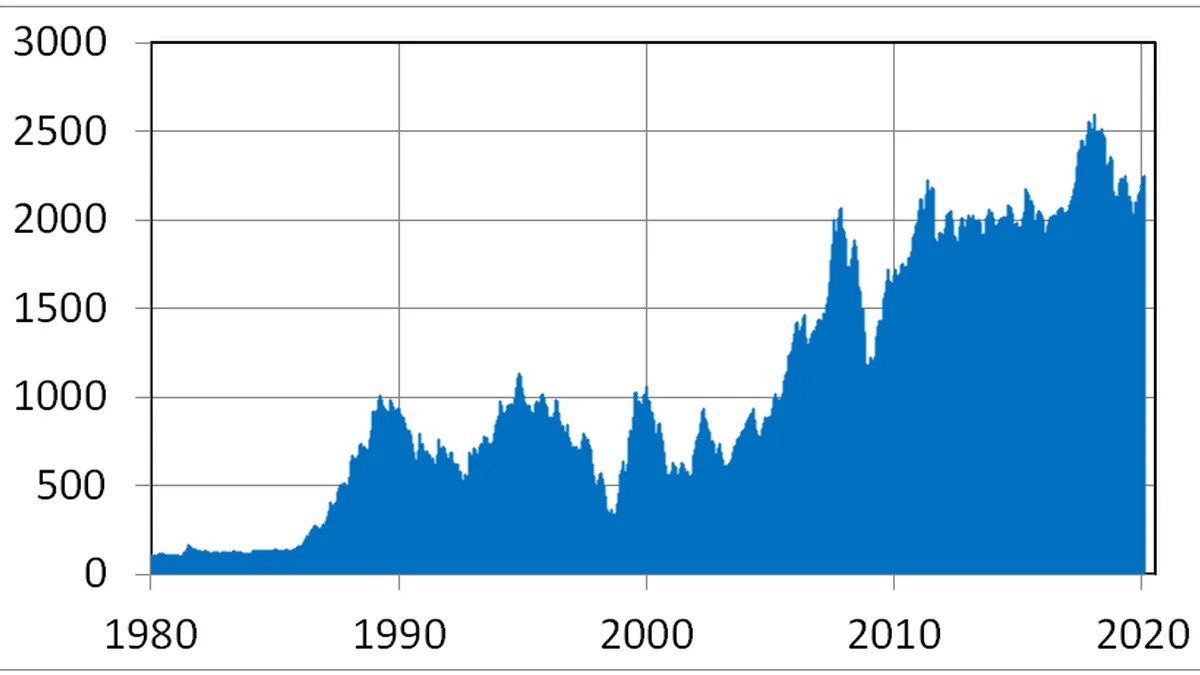
The Kospi is the primary stock market index of South Korea. It was launched in the early 1980s by the Korea Exchange (KRX). The index was created to provide a benchmark for the overall performance of the South Korean stock market. Its calculation methodology and base value were established with a starting date in January 1980. The Kospi has undergone several significant changes in its composition and calculation method since its inception. These changes reflect the evolution of the South Korean economy and its financial markets. The index is maintained and calculated by the Korea Exchange, which was formed through the merger of the country's previous stock, futures, and bond exchanges in the early 2000s.
What it is for
The Kospi serves as the core benchmark for tracking the performance of large-cap stocks listed on the Korea Exchange's main board, known as the Kospi Market. Its primary function is to provide investors with a single, representative measure of the South Korean equity market's overall health and direction. Institutional and retail investors use the index to gauge market sentiment and economic trends within the country. The performance of the Kospi is a key economic indicator for both domestic and international observers of the South Korean economy. Many financial products, such as index funds, exchange-traded funds (ETFs), and derivatives, are directly linked to the Kospi's value. The index also serves as a basis for international comparison, allowing global investors to assess South Korea's market relative to other major indices worldwide.
Pros and cons
A primary advantage of the Kospi is its high liquidity and the deep, established market it represents, offering investors exposure to major South Korean conglomerates and leading industrial sectors. The index provides a relatively straightforward way to gain broad exposure to the developed Korean economy without selecting individual stocks. However, the Kospi is notoriously volatile, often experiencing sharp swings driven by geopolitical tensions related to the Korean peninsula and fluctuations in global risk sentiment. A significant con is its heavy concentration in a few large-cap stocks, particularly from the technology and industrial sectors, meaning the index's movement can be disproportionately influenced by a handful of companies. Investors who seek diversified exposure within South Korea may find the Kospi lacking, as it does not represent small- and mid-cap companies, which are covered by a separate index. A common mistake is treating the Kospi as a complete proxy for the Korean economy, overlooking the fact that its composition can lead to sector-specific risks that do not reflect broader economic conditions.
Who it suits
The Kospi primarily suits investors seeking direct exposure to the large-cap segment of the South Korean equity market. It is appropriate for institutional investors, such as pension funds and asset managers, who require a core benchmark for their Korean equity allocations. Traders comfortable with high volatility and geopolitical risk may utilize the index or its derivatives for short- to medium-term tactical positions. The index is also suitable for passive investors through ETFs and index funds that replicate its performance, offering a cost-effective way to gain that market exposure. It is less suited for investors looking for stable, dividend-focused income, as the constituent companies often prioritize growth over shareholder payouts. Finally, the Kospi is a critical tool for economists and analysts monitoring the performance of Asia's major developed economies and global supply chain dynamics.