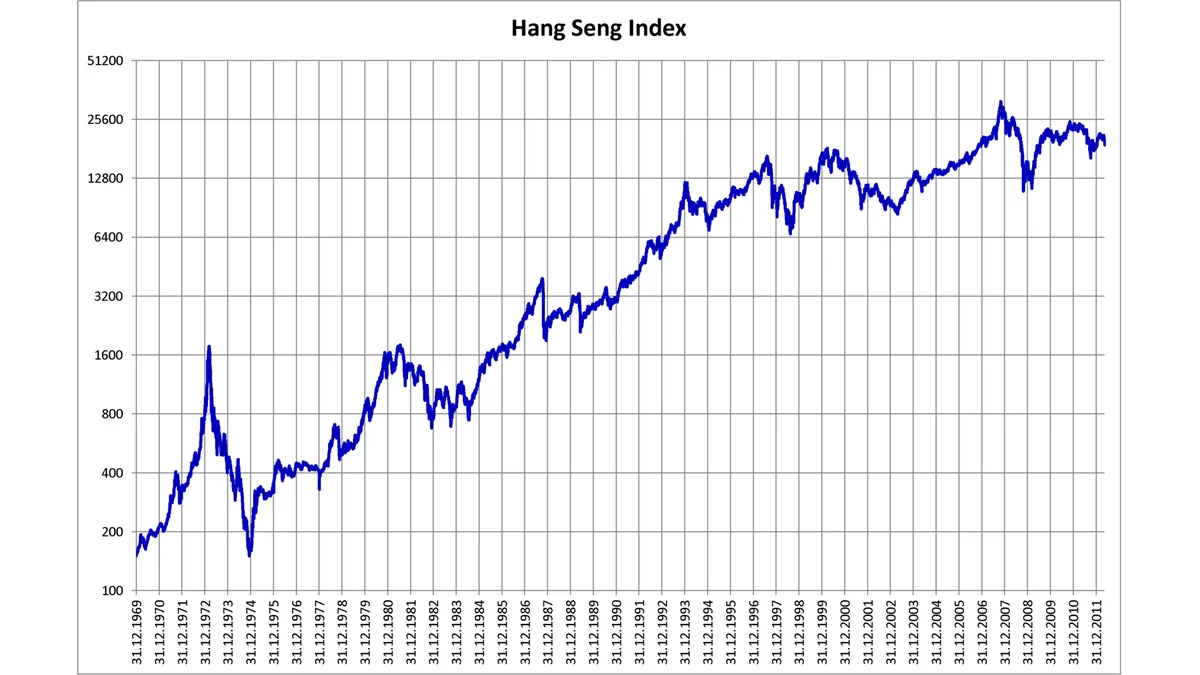
Hang Seng
| Index name | Hang Seng Index |
|---|---|
| Exchange | Hong Kong Stock Exchange |
| First created | 1969 |
| Number of constituent stocks | Variable (typically 50–80) |
| Calculation method | Free-float adjusted market capitalization-weighted |
| Trading currency | Hong Kong dollar (HKD) |
| Session hours | 09:30–16:00 local time (with a midday break) |
Origin and history
The Hang Seng Index originates from Hong Kong and was first published in the late 1960s. It was created by the Hang Seng Bank to provide a general indicator of daily market movements in the Hong Kong stock market. The index was initially calculated on a base date in 1964, with its official public launch occurring several years later. Its development was driven by the need for a standardized benchmark as Hong Kong's financial sector grew in regional importance. The methodology was designed to track the largest and most liquid companies listed on the Hong Kong exchange. The index has undergone significant changes in its composition and calculation method over the decades to reflect the evolving economy.
What it is for
The Hang Seng Index serves as the primary benchmark for the performance of the Hong Kong stock market. It is designed to represent the overall market movements of the largest and most liquid companies listed on the Hong Kong Stock Exchange. Institutional and retail investors use the index to gauge the health of the Hong Kong market and the broader regional economy. The index is the underlying asset for a vast array of financial products, including futures, options, and exchange-traded funds (ETFs). Fund managers often use it as a performance benchmark for portfolios focused on Hong Kong or Chinese equities. Its composition makes it a key indicator for sectors like finance, property, and technology that dominate the Hong Kong market.
Pros and cons
A primary advantage of the Hang Seng Index is its high liquidity and the deep market it represents, facilitating large institutional trades. It offers concentrated exposure to major Chinese companies that list in Hong Kong, serving as a gateway to China's economy. However, its composition is heavily weighted toward a few sectors, notably finance and real estate, leading to a lack of diversification. The index can exhibit extreme volatility, driven by its sensitivity to shifts in global liquidity and regional geopolitical tensions. Investors often regret using it as a standalone proxy for Asian or Chinese growth, as it misses broader industrial and consumer sectors listed domestically in China. A common mistake is overlooking the significant impact of currency fluctuations, as the index is denominated in Hong Kong dollars but reflects earnings often in other currencies.
Who it suits
The Hang Seng Index suits institutional investors and fund managers seeking a benchmark for dedicated Hong Kong or Greater China equity mandates. It is appropriate for traders with a focus on Asian markets who can actively manage the risks associated with its volatility and sector concentration. The index serves speculators looking to take directional views on Hong Kong's financial market or macroeconomic developments in China through derivatives. Long-term investors with a strong conviction in the stability and growth of Hong Kong's listed blue-chip companies may use it for core exposure. It is less suited to novice investors or those seeking a diversified, stable portfolio representative of the entire Asian region. The index primarily caters to market participants who understand the unique political, economic, and regulatory environment of Hong Kong.